“Just Downloading It is a Subversive Act” – Telegram Attracts Lockdown Opponents as Well as Privacy Fans

While the press in the United States has understandably focused their reporting any whatever anti-lockdown protests that happen on those taking place domestically, a fairly vigorous protest movement has also appeared in Germany. The sometimes violent demonstrations – which have seen thousands taking to the streets in Stuttgart, Munich, and Berlin – seem however to be attracting a broader set of political viewpoints and themes than the US version, ranging from those concerned about the erosion of constitutional rights all the way to anti-vaccination conspiracists (centered largely around Bill Gates.) Although these protests have been necessarily small-scale due to public-health restrictions, discontent with the government’s anti-coronavirus measures have had a surprising impact on how the public is using technology.

What is Telegram?

The messaging app Telegram is relatively little-known in the United States with far fewer monthly users than more-established apps such as Facebook Messenger and Snapchat. In fact, those two messaging combined apps boasted over 150 million users in the United States in April 2019 compared to just under 3.5 million for Telegram. By comparison, Telegram had 7.8 million monthly users in Germany in November 2019 (contrasted with a combined 76 million for WhatsApp and Facebook Messenger.) The organization behind Telegram, which was founded in 2013 by Russian brothers Nikolai and Pavel Durov (who also founded the Russian equivalent to Facebook, Vkontakte, in 2007), does not disclose where it rents offices in order to protect users’ data. (The brothers Durov currently live in Dubai, but they are silent about who or where the rest of Telegram is.) This stance could explain Telegram’s sudden popularity among the segment of the population that sees restrictions on movement or assembly as excessive or authoritarian.

What Makes Telegram So Appealing?

The German public is generally seen as skeptical if not outright skittish in sharing personal electronic data, which some researchers have ascribed to the country’s experience with totalitarian surveillance. Unsurprising then is widespread unease that has met proposals to use cell phones to track and trace part of the population to limit the spread of COVID-19. Telegram’s brand of cryptographed libertarianism has therefore found fertile ground among not just users who value data privacy but also for those who share messages that might otherwise be removed based on potentially objectionable content.

Although the German government has been striving to get tech giants like Facebook and Twitter to quickly remove certain illegal content, so far Telegram has proven untouchable. Pavel Durov has even stated that he will only assist the police with copyright violations, terrorist propaganda, and child pornography. For him, governments are otherwise monstrous entities that only serve to limit the individual and that “local restricts on freedom of speech do not matter.” For instance, German laws that criminal speech that denies or trivializes the Holocaust – and that lead to immediate removal from Facebook – are simply ignored. Telegraph is also partially or completely blocked in Russia, China, and Iran because the company refuses to hand over user data to authorities.

This seeming shroud of secrecy means that some users consider merely downloading the app to be a “subversive act” that skirts speech restrictions and keeps users’ personal data hidden. Since the start of the COVID crisis, celebrities like the vegan TV chef Attila Hildmann and the pop star Xavier Naidoo have used their significant Telegram followings to disseminate conspiracy theories about mandatory vaccination or secret underground bunkers where children are kept.

Combatting Coronavirus Conspiracies

Naturally there has been massive pushback on these unsupported statements—however with much of that coming from government-owned public channels or establishment media such criticism might often fall on deliberately deaf ears. The massive reach of Telegram’s user groups as compared to WhatsApp also reinforces the informational bubble that allow conspiracy theories, if not speech deemed illicit in Germany, to spread unchecked. Whereas a WhatsApp group has an upper limit of 256 users, groups on Telegram can be as large as 100,000 users (almost as much as the circulation of some national newspapers.) Just a few large accounts combined creates a parallel media landscape operating outside restrictions on speech, either imposed by lawmakers or formulated by social media companies themselves.

Are Current Online Hate Speech Laws Effective?

This is precisely what some critics of Germany’s online hate speech laws had warned about. Objectionable speech would not vanish once objectionable content was removed from Facebook or YouTube. Rather, it would simply move to other, more private platforms that would operate outside of any form of social or legal control such as closed messenger groups. Martin Fehrensen, a German social media expert and founder of the Social Media Watchblog, observes that such users retreat into their own “private” spheres within messenger services. These chat groups operate outside of any “filtering” algorithms, which have an “enormous influence” on what content is shown. Fehrensen also claims that the current system by which Facebook and YouTube operate functions well in that users who post objectionable material will have to contend with pushback from other users they are connected with. By contrast, Telegraph’s limited functionality means that administrators of a chat group alone act as gatekeepers and can decide to exclude members for whatever reason, thereby building an echo chamber in which aberrant world views only grow more robust.

If Fehrensen’s view is correct that social media’s own content gatekeepers, combined with the potentially suppressing function of algorithms and users’ role as content stakeholders, can keep objectionable material to a minimum, this may show another – and perhaps more effective – way to tackle the problem than with massive fines and unrealistic deadlines that can never achieve the ideal of a civil and fact-based Internet. As Telegram shows, spaces where bizarre conspiracies and sometimes outright hatred will likely exist despite laws to curb disinformation and ethnically or religiously based agitation. Social media companies can perhaps get ahead of an avalanche of new laws by showing it can effectively patrol its own while making extralegal echo chambers less appealing.

Germany’s “Facebook Law” to be Tightened to Combat Far-Right Hate Speech Online

February 19, 2020 saw two events in Germany that illustrate that country’s struggle to grapple with neo-Nazi violence and hate speech online. In the morning, the Cabinet of Chancellor Merkel signed off on proposed amendments to a law that requires social media companies to act when made aware of postings that contravene German laws on personal insults, agitation against minorities, or threats of sexual violence. That same evening, a man in the town of Hanau near Frankfurt shot and killed nine people in two shisha bars, all of whom were either immigrants or had immigrant backgrounds. While so far there has been no indication that the shooter had any contact to neo-Nazi groups, the fact that he posted online a manifesto and videos containing racist and xenophobic sentiments is certain to intensify the debate on how to control online hate speech and what social media companies’ duties are under the law to combat this threat.

The Current State of the Law: the Netzwerkdurchsetzungsgesetz

Social media companies such as Facebook and Google operating in Germany are already subject to a 2017 law called the Netzwerkdurchsetzungsgesetz (abbreviated as NetzDG and sometimes informally called the “Facebook Law”) that requires them to act on certain kinds of postings. In cases in which a social media company with over 2 million users in Germany receives a complaint about “obviously illegal” content, that company must delete or block the post within 24 hours of receiving the complaint. This provision means that the social media companies themselves must decide what content is or is not a violation of applicable German law. Networks that fail to comply with the law can be assessed fines of up to 5 million Euros per violation.

Proposed Tightening of the NetzDG

While the proposed amendments to the NetzDG still need to be debated and ratified by the Bundestag (Germany’s parliament), social media companies will see their legal obligations multiply should the proposals indeed become law. In fact many of these proposed provisions have shown to be controversial, so some changes to the bill are likely before it is approved. Nevertheless, the changes are sweeping. Social networks will be required not only to delete or block illegal content but to also inform the German criminal office, the Bundeskriminalamt (roughly equivalent to the FBI), so that the authors of such content can be referred for prosecution. Most controversially, social networks would also need to provide the user’s IP address and account password. Furthermore, social networks would need to do this on their own initiative, rather than react to a complaint about such content, so they will need to begin monitoring their own content much more closely. Types of content that are covered under these proposals include disseminating propaganda of outlawed organizations (such as parties promoting an explicitly Nazi ideology), incitement against ethnic or religious minorities, and child pornography. And while the proposals seek to combat “right wing” extremism (in fact the impetus behind the changes was the assassination of a German politician by a neo-Nazi in June 2019), the provision that also covers content forbidding “preparation of acts of violence against the state” or “support for terrorist groups” could also extend to organizations such as ISIS.

Criticism of the Proposals Coming from All Sides

Seemingly nobody is happy with what these proposals would entail. The German Association of Lawyers (DAV, or Deutscher Anwaltverein) stated in a press release on February 26 that it finds the “planned expansion of the reporting obligations of the operators of social networks to be extremely problematic.” In particular, the amendments would encourage social networks to use Artificial Intelligence to identify and delete content automatically, and since “no software, however ‘intelligent’, can currently distinguish lawful from illegal or even punishable statements” this preemptive removal of content could constitute illicit censorship. The Association for Internet Economy eco (a private eCommerce organization) characterized the requirement to hand over a user’s password as a measure that would lead to widespread social distrust in technology since a password grants access to not merely the potentially illicit content at issue but potentially to a user’s entire digital life.

Further fears of censorship have been expressed across the German political spectrum. From the left side of the aisle, the newspaper Neues Deutschland (“New Germany,” which was once the newspaper of record of the Communist party that ruled East Germany) raised the possibility that “American digital enterprises” will determine the parameters of free speech in Germany since their “fear of state-imposed fines” would lead to content being deleted even if it is protected by law. The free-market oriented Free Democratic Party echoed this sentiment and stated that this law is a “Trojan horse for freedom of speech” that would create a “database of suspects” with the BKA.

What’s Next with the NetzDG?

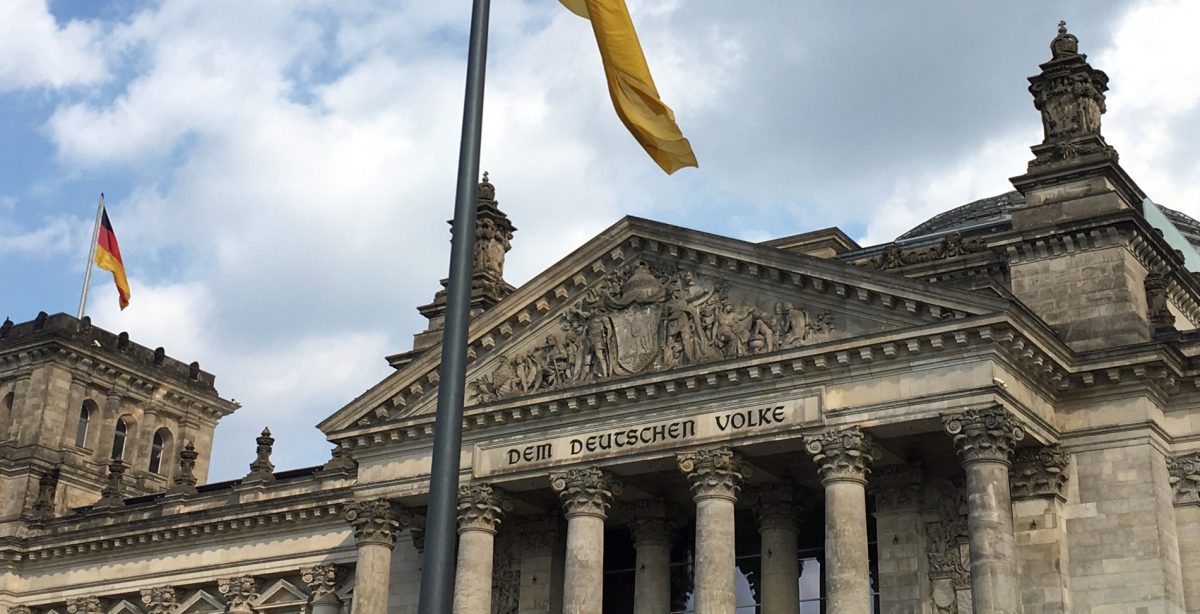
Even though these proposals to the NetzDG were approved by Chancellor Merkel’s cabinet—specifically the Minister of Justice and Consumer Protection, Christine Lambrecht of the Social Democratic Party—the shape of the Internet in Germany at some point soon will be debated by lawmakers beneath the dome of the old Reichstag building in Berlin. Given that even organizations that were founded specifically to combat right-wing violence have been critical of a law intended to do just that, it seems likely that something will change when the final version is approved, probably this spring. Nevertheless, there seems to be a growing desire in Germany to do more somehow to stanch the increase in far-right activity (though not just online), and this bill might survive its many criticisms. Further complicating matters are the competing levels of law within the European Union which may offer social media users more privacy protections than the NetzDG foresees, although Brussels is unlikely to get involved at any point soon.

This debate does of course underscore once again the intricate legal landscape that binds Berlin and Silicon Valley. Nearly every piece in the German press discussing curbs on far-right hate speech references Facebook, Instagram, Google, or YouTube—all headquartered in the Bay Area—even if the problem is one that seems to have its most fertile ground in the still-disadvantaged regions of the former East Germany.