February 19, 2020 saw two events in Germany that illustrate that country’s struggle to grapple with neo-Nazi violence and hate speech online. In the morning, the Cabinet of Chancellor Merkel signed off on proposed amendments to a law that requires social media companies to act when made aware of postings that contravene German laws on personal insults, agitation against minorities, or threats of sexual violence. That same evening, a man in the town of Hanau near Frankfurt shot and killed nine people in two shisha bars, all of whom were either immigrants or had immigrant backgrounds. While so far there has been no indication that the shooter had any contact to neo-Nazi groups, the fact that he posted online a manifesto and videos containing racist and xenophobic sentiments is certain to intensify the debate on how to control online hate speech and what social media companies’ duties are under the law to combat this threat.
The Current State of the Law: the Netzwerkdurchsetzungsgesetz
Social media companies such as Facebook and Google operating in Germany are already subject to a 2017 law called the Netzwerkdurchsetzungsgesetz (abbreviated as NetzDG and sometimes informally called the “Facebook Law”) that requires them to act on certain kinds of postings. In cases in which a social media company with over 2 million users in Germany receives a complaint about “obviously illegal” content, that company must delete or block the post within 24 hours of receiving the complaint. This provision means that the social media companies themselves must decide what content is or is not a violation of applicable German law. Networks that fail to comply with the law can be assessed fines of up to 5 million Euros per violation.
Proposed Tightening of the NetzDG
While the proposed amendments to the NetzDG still need to be debated and ratified by the Bundestag (Germany’s parliament), social media companies will see their legal obligations multiply should the proposals indeed become law. In fact many of these proposed provisions have shown to be controversial, so some changes to the bill are likely before it is approved. Nevertheless, the changes are sweeping. Social networks will be required not only to delete or block illegal content but to also inform the German criminal office, the Bundeskriminalamt (roughly equivalent to the FBI), so that the authors of such content can be referred for prosecution. Most controversially, social networks would also need to provide the user’s IP address and account password. Furthermore, social networks would need to do this on their own initiative, rather than react to a complaint about such content, so they will need to begin monitoring their own content much more closely. Types of content that are covered under these proposals include disseminating propaganda of outlawed organizations (such as parties promoting an explicitly Nazi ideology), incitement against ethnic or religious minorities, and child pornography. And while the proposals seek to combat “right wing” extremism (in fact the impetus behind the changes was the assassination of a German politician by a neo-Nazi in June 2019), the provision that also covers content forbidding “preparation of acts of violence against the state” or “support for terrorist groups” could also extend to organizations such as ISIS.
Criticism of the Proposals Coming from All Sides
Seemingly nobody is happy with what these proposals would entail. The German Association of Lawyers (DAV, or Deutscher Anwaltverein) stated in a press release on February 26 that it finds the “planned expansion of the reporting obligations of the operators of social networks to be extremely problematic.” In particular, the amendments would encourage social networks to use Artificial Intelligence to identify and delete content automatically, and since “no software, however ‘intelligent’, can currently distinguish lawful from illegal or even punishable statements” this preemptive removal of content could constitute illicit censorship. The Association for Internet Economy eco (a private eCommerce organization) characterized the requirement to hand over a user’s password as a measure that would lead to widespread social distrust in technology since a password grants access to not merely the potentially illicit content at issue but potentially to a user’s entire digital life.
Further fears of censorship have been expressed across the German political spectrum. From the left side of the aisle, the newspaper Neues Deutschland (“New Germany,” which was once the newspaper of record of the Communist party that ruled East Germany) raised the possibility that “American digital enterprises” will determine the parameters of free speech in Germany since their “fear of state-imposed fines” would lead to content being deleted even if it is protected by law. The free-market oriented Free Democratic Party echoed this sentiment and stated that this law is a “Trojan horse for freedom of speech” that would create a “database of suspects” with the BKA.
What’s Next with the NetzDG?
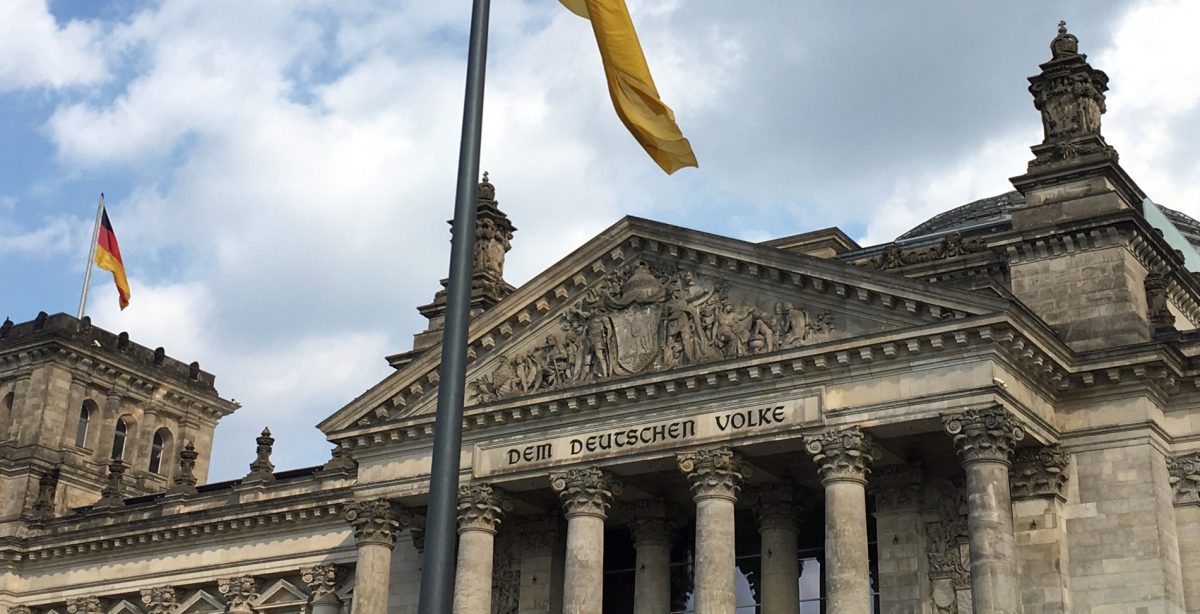
Even though these proposals to the NetzDG were approved by Chancellor Merkel’s cabinet—specifically the Minister of Justice and Consumer Protection, Christine Lambrecht of the Social Democratic Party—the shape of the Internet in Germany at some point soon will be debated by lawmakers beneath the dome of the old Reichstag building in Berlin. Given that even organizations that were founded specifically to combat right-wing violence have been critical of a law intended to do just that, it seems likely that something will change when the final version is approved, probably this spring. Nevertheless, there seems to be a growing desire in Germany to do more somehow to stanch the increase in far-right activity (though not just online), and this bill might survive its many criticisms. Further complicating matters are the competing levels of law within the European Union which may offer social media users more privacy protections than the NetzDG foresees, although Brussels is unlikely to get involved at any point soon.
This debate does of course underscore once again the intricate legal landscape that binds Berlin and Silicon Valley. Nearly every piece in the German press discussing curbs on far-right hate speech references Facebook, Instagram, Google, or YouTube—all headquartered in the Bay Area—even if the problem is one that seems to have its most fertile ground in the still-disadvantaged regions of the former East Germany.
 GermanLegalBlog.com