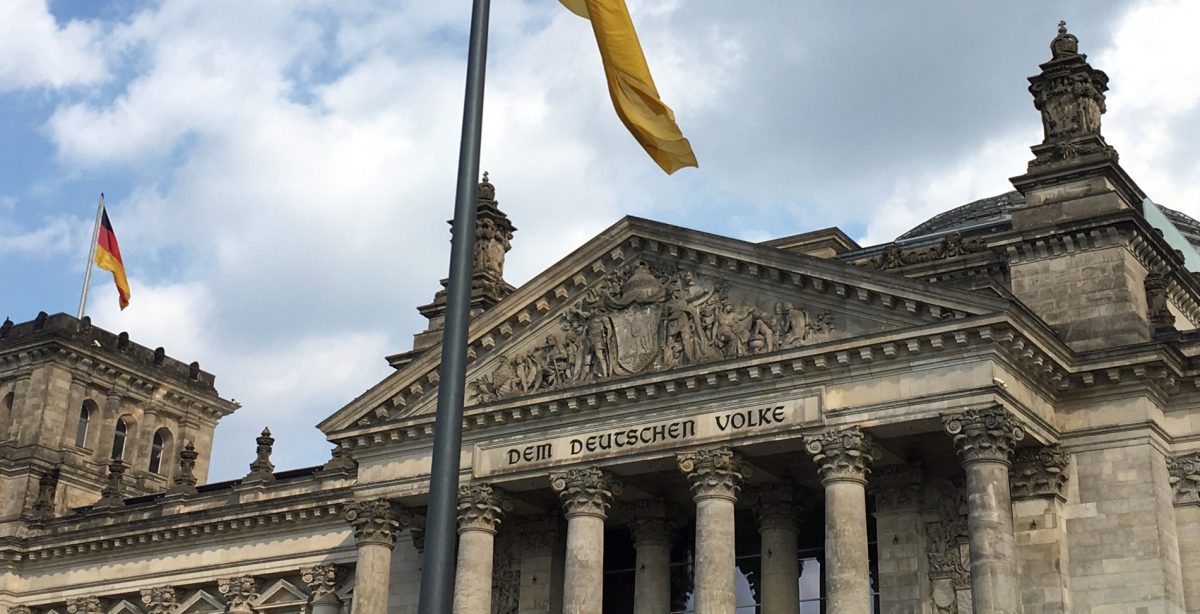
On May 14, 2020, the German Bundestag (Parliament) approved a new law that expanded existing prohibitions on flag-burning to cover all national flags as well as the flag of the European Union. Previously, a person could face fines or imprisonment only for burning the flag of the Federal Republic of Germany or of any of the federal states that make up Germany, such as Bavaria. This law adds an additional section to Paragraphs 90(a) and 90(b) to the Penal Code (Strafgesetzbuch) to encompass any national flag — or even flags that are similar enough to an official national flag that it could be easily mistaken for the official version. A possible prison sentence for a conviction under this law could be up to three years.
The impetus for expanding the existing law were images of Israeli flags being burned at a demonstration in Berlin in 2017 in front of the United States embassy beside the Brandenburg Gate in response to the White House announcing that it plans to move its embassy from Tel Aviv to Jerusalem (the US embassy in Berlin also abuts the vast Memorial to the Murdered Jews of Europe, on a large swath of land that formerly fell within the “no-man’s land” of the Berlin Wall.) The sight of the Star of David (on the Israeli flag) in flames caused consternation and outrage among German lawmakers. Thorsten Frei of Chancellor Angela Merkel’s Christian Democratic Union party stated that “in no way can we tolerate in Germany actions that maliciously denigrate another nation; the Justice Minister, Christine Lambrecht, of the co-governing Social Democratic Party has stated that “burning flags . . . has nothing to do with peaceful protests. It is intended to stir up hate, rage, and aggression.”
Burning the flag of the European Union, while not common in Germany, was a recent social-media trend in Italy as Italians filmed themselves at home burning color print-outs of the EU flag in protest at perceived abandonment by Brussels and other wealthier EU states, especially Germany, during the coronavirus crisis. While the new German law states that “whoever publicly destroys or damages the flag of a foreign state and thereby disparages it” shall be punished (italics added), in light of increased penalties for online hate-speech that were passed this week in France and similar pending proposals in Germany, it may be worth considering if, say, a YouTube video showing someone burning an Israeli flag could run afoul of hate-speech prohibitions.
One argument that could be raised in favor of such a claim is that while a demonstrator burning a flag at a protest may be seen by a few hundred people who were present in close proximity to the demonstrator, and the burning of a flag lasts only a minute or two before the fire is extinguished, a video could reach many thousands of people over a time frame lasting many months or years. In the context of, for example, chants decrying the nation whose flag a person is filming himself burning (“DEATH TO…….!!!”), some politicians may very well claim that this is the type of content that Facebook or Twitter need to remove within 24 hours or face many thousands of Euros in fines. While the United States Supreme Court in 1989 ruled that burning the flag of the United States is protected speech (as presumably would be burning the flag of any other country), European and especially German sensibilities on this matter are very different from American concepts that are underpinned by the First Amendment. Social media companies may soon find themselves grappling with very expansive and generous definitions of “hate speech” as defined by European governments.
 GermanLegalBlog.com